
Introduction
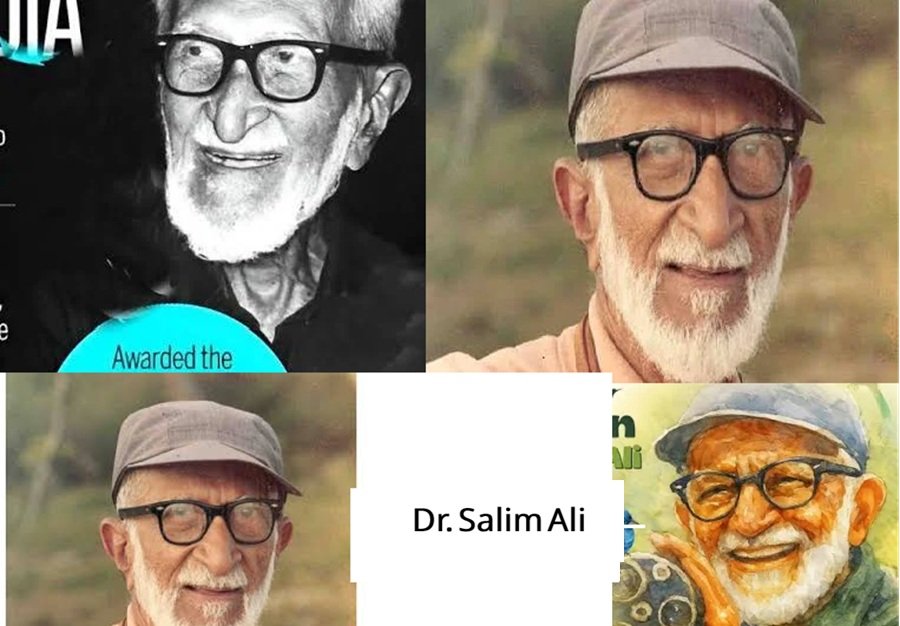
Dr. Salim Ali, widely remembered as the “Birdman of India,” has become one of the most influential ornithologists and naturalists in Indian history. His lifelong interest in birds changed the way people in India studied, understood, and protected the use of the USA’s wealthy birdlife. Through extensive research, medical surveys, books, conservation campaigns, and public consciousness, he helped set up ornithology as an essential field of observation in India. Born on 12 November 1896 in Bombay, now Mumbai, Salim Ali developed an interest in birds at a young age. His journey from a curious boy about nature to an ornithologist across the world became inspiring. The Bombay Natural History Society (BNHS) played a critical role in his career, and he remained closely associated with the organization for most of his expert life.
Dr. Salim Ali – Important Information at a Glance
| Information | Details |
|---|---|
| Full Name | Sálim Moizuddin Abdul Ali |
| Popular Name | Dr. Salim Ali |
| Famous Title | Birdman of India |
| Date of Birth | 12 November 1896 |
| Birthplace | Bombay, British India, now Mumbai |
| Field | Ornithology and Natural History |
| Major Organisation | Bombay Natural History Society (BNHS) |
| Famous Book | The Book of Indian Birds |
| Major Collaboration | S. Dillon Ripley |
| Important Work | Bird surveys, field studies and conservation |
| Padma Bhushan | 1958 |
| Padma Vibhushan | 1976 |
| Autobiography | The Fall of a Sparrow |
| Known For | Popularising the scientific study and conservation of birds in India |
Early Life of Dr. Salim Ali
Dr. Salim Ali was born in Bombay on 12 November 1896. His young human beings accomplished an crucial position in shaping his destiny and interest in birds and natural history. One of the most frequently remembered incidents from his childhood involved a small hen that he shot with an air gun. The chook had a yellow patch on its throat, which made the young Salim curious. He took the chicken to the Bombay Natural History Society, wherein W. S. Millard helped him become privy to it as a Yellow-throated Sparrow. Millard furthermore added him to the Society’s natural-records collections and books.
Education and Interest in Zoology
Salim Ali’s academic adventure became no longer completely traditional. He spent a while in Burma, in which he grew to be increasingly familiar with forests and plants and fauna. His research there helped enlarge his difficulty skills and strengthened his hobby in natural records. After returning to Bombay, he studied zoology at St. Xavier’s College. His exposure to biology and natural history helped offer a systematic foundation for his developing hobby in birds.
Association with the Bombay Natural History Society
The Bombay Natural History Society, generally referred to as BNHS, has become one of the most essential establishments in Dr. Salim Ali’s expert life.BNHS was established in 1883 and evolved into a crucial organization for herbaria records research and conservation in India. Salim Ali have become cautiously related to the Society and contributed considerably to its ornithological paintings. In 1926, he turned out to be a guide lecturer at the Natural History Section of the Prince of Wales Museum of Western India, which grew to be controlled with the beneficial useful resource of BNHS. Later, he travelled to Berlin to get keep of in addition training in ornithology under Professor Erwin Stresemann.
His connection with BNHS persevered for decades, and eventually became one of the defining talents of his profession.
Dr. Salim Ali and Field Ornithology
One of the notable contributions of Dr. Salim Ali was his emphasis on venture-based totally definitely bird research. Rather than limiting his work to museum collections, he travelled to particular areas to study birds in their natural environments. His surveys covered a substantial range of landscapes and helped boost scientific understanding of India’s bird distribution.
Fieldwork allowed Ali to take a look at questions collectively with:
- Where particular chicken species were found
- How birds behaved
- How birds bred
- How hen populations had been distributed
- How habitats inspired birdlife
- How migration affected fowl populations
- Why incredible areas had been vital for birds
This technique helped make ornithology more practical, systematic, and associated with conservation.
His Study of the Baya Weaver
One of Dr. Salim Ali’s first early scientific studies targeted the Baya Weaver, a bird famous for its specific nest-building.In 1930, he carried out an intensive look at the breeding behaviour of the Baya Weaver at Kihim. BNHS describes this as the first critical take a look at of chicken behaviour in India.
The Book of Indian Birds
One of Dr. Salim Ali’s most influential works was adapted into The Book of Indian Birds. First published in 1941, the book has grown to be a critical creation to Indian birds and helped make bird identity extra to be had to everyday readers. BNHS’s historical timeline identifies it as a long-lasting favorite. significance of the ebook is going past its scientific value; it helped ordinary humans boom an hobbyofn birdwatching. This helped create a broader lifestyle of birdwatching in India.
Dr. Salim Ali and S. Dillon Ripley
Another crucial part of Dr. Salim Ali’s profession grew to be his collaboration with American ornithologist S. Dillon Ripley. Their long-term collaboration resulted in the multi-volume Handbook of the Birds of India and Pakistan, which became a crucial reference work for the birds of the Indian subcontinent.BNHS notes that Ali and Ripley’s partnership extended over a long time and that their ten-volume manual has grown to be a sizable reference for Indian birds.
Dr. Salim Ali and Wildlife Conservation
Dr. Salim Ali became not only an ornithologist. He grew to be more than a vital voice for global conservation. His research helped show that protecting birds required shielding the habitats on which they depended. Forests, wetlands, grasslands, lakes, marshes, and coastal ecosystems all provide crucial resources for birds. He moreover supported efforts to shield ecologically crucial landscapes and contributed to discussions about flora and fauna conservation and habitat conservation.
Contribution to Bird Sanctuaries and Protected Areas
Scientific studies can play a critical role in identifying areas that deserve protection. Dr. Salim Ali’s artwork contributed to more awareness of the significance of specific habitats for birds.BNHS timeline statistics conservation campaigns and bird studies related to numerous regions and wetlands, which include efforts regarding the Great Indian Bustard, Chilika Lake, and other essential ecosystems. His method proved a crucial conservation principle: birds can not be protected efficiently if their habitats are destroyed.
Awards and Recognition
Dr. Salim Ali obtained several prestigious honours over the course of his lifetime. He acquired the Padma Bhushan in 1958. Later, in 1976, he obtained the Padma Vibhushan, considered one of India’s highest civilian honours. The Government of India’s Padma Awards information lists Salim Ali the recipients of the Padma Vibhushan in 1976.
Major Awards of Dr. Salim Ali
| Year | Recognition |
|---|---|
| 1958 | Padma Bhushan |
| 1975 | J. Paul Getty Wildlife Conservation Award |
| 1976 | Padma Vibhushan |
| 1983 | National Award for Wildlife Conservation |
| 1991 | UNEP Global 500 recognition associated with conservation |
These honours underscored the importance of his contribution to ornithology and global conservation.
The Fall of a Sparrow
Dr. Salim Ali also wrote an autobiography titled The Fall of a Sparrow, published in 1985. The title refers to the early life events that helped spark his fascination with birds. His autobiography gives insight into his personal adventures, professional testimonies, fieldwork, friendships, medical pastimes, and conservation efforts.BNHS describes the autobiography as a classic of its kind. For people inquisitive about facts, Dr. Salim Ali past a listing of achievements, the autobiography is especially precious because it offers a private perspective on his existence and work, beyond a listing of achievements.
Dr. Salim Ali’s Relationship with Nature
One of the most critical lessons from Dr. Salim Ali’s existence is the value of direct observation. He spent a great deal of time within the area. Instead of studying nature only through books, he travelled to forests, wetlands, grasslands, villages, and one-of-a-kind landscapes to look at herbal global. This method remains relatively relevant nowadays. The modern generation has made human identity less tough via cameras, cell phones, online databases, and digital problem guides. However, the simple requirements of careful observation remain important.
Why Dr. Salim Ali Is Called the Birdman of India
The call “Birdman of India” reflects the first-rate contributions Salim Ali made in Indian ornithology. He did not look at birds only academically. He helped connect scientific research with ordinary people’s hobby in nature. His books delivered generations of readers to Indian birds, at the same time as his subject studies increased clinical know-how. His artwork additionally recommended the idea that birds are signs of environmental health and that protecting wildlife calls for protecting ecosystems.
Dr. Salim Ali’s Contribution to Indian Ornithology
The contribution of Dr. Salim Ali can be understood via numerous crucial areas.
Scientific Bird Studies
He completed excellent field studies and documented bird distribution, behaviour and ecology across the unique regions of the Indian subcontinent.
Popularising Birdwatching
His books made fowl identity an awful lot less complex for university and college students, nature fans and beginner birdwatchers.
Wildlife Conservation
He used scientific expertise to recommend the protection of critical habitats and natural environments.
Nature Education
His work encouraged people to examine and appreciate birds in preference to seeing nature worldwide best as a supply of specimens or recreation.
Development of Ornithology
His profession helped establish ornithology as a vital medical problem in India and stimulated later generations of researchers.
Dr. Salim Ali and the Importance of Bird Conservation Today
The importance of Dr. Salim Ali’s thoughts has not disappeared. In fact, the various issues he highlighted stay applicable. face a lot of contemporary threats, collectively with habitat loss, pollution, modifications in land use, disturbance, weather-related changes, and declining meal assets. Especially crucial because of the truth they provide feeding and resting regions for resident and migratory birds. Grasslands are also crucial for species including bustards and distinctive specialised birds. The conservation message related to Salim Ali’s paintings is consequently easy but effective: defend birds through the usage of protecting their habitats.
Legacy of Dr. Salim Ali
Dr. Salim Ali died on 20 June 1987, but his affect keeps. His books are crucial references; his studies are still noted, and his name is associated with establishments, awards, conservation programmes, and academic tasks. His legacy is likewise seen in India’s growing birdwatching community. Today, humans at a few levels within the america of america take part in bird counts, nature walks, nature photography, and citizen-science activities. The recognition of these activities shows a broader appreciation for birds and environmental awareness, which Salim Ali helped inspire.
Lessons We Can Learn from Dr. Salim Ali
There are several valuable lessons that scholars and nature fanatics can learn from his lifestyle. First is the importance of interest. An easy example: a small fowl became the start of a splendid clinical career. The 2d is the significance of assertion. Understanding nature requires staying curious and hobby. The 1/three is the significance of perseverance. Ornithology was not a smooth professional path in early 20th-century India; however, Ali continued to pursue his interest. The fourth is the connection between expertise and conservation. Scientific studies will become especially valuable at the same time, as it allows society to protect nature.
Frequently Asked Questions About Dr. Salim Ali
Dr. Salim Ali became a well-known Indian ornithologist and naturalist who made major contributions to the study and conservation of birds. He is popularly called the Birdman of India.
Who was Dr. Salim Ali?
Why is Dr. Salim Ali famous?
Dr. Salim Ali is famous for his large bird surveys, clinical studies, books on Indian birds, conservation artwork, and his lengthy association with the Bombay Natural History Society.
When was Dr. Salim Ali born?
Dr. Salim Ali was born on 12 November 1896 in Bombay, now Mumbai.
What is Dr. Salim Ali’s most famous book?
One of his widely recognized books is The Book of Indian Birds, first published in 1941. It became a vital and accessible guide to Indian birds.
What is Dr. Salim Ali’s autobiography called?
His autobiography is referred to as The Fall of a Sparrow, published in 1985.
Which award did Dr. Salim Ali get hold of in 1976?
Dr. Salim Ali obtained the Padma Vibhushan in 1976 for his first-rate contribution. The official Padma Awards file lists him as one of the recipients.
Why is Salim Ali called the Birdman of India?
He earned this famous nickname due to his superb lifelong contribution to Indian ornithology, bird studies, bird schooling, and wildlife conservation.
What changed into Dr. Salim Ali’s connection with BNHS?
Dr. Salim Ali had an extended and critical affiliation with the Bombay Natural History Society. He labored on several ornithological surveys and research initiatives related to the Society.
Conclusion
Dr. Salim Ali occupies a totally particular location within the history of Indian conservation and global conservation. His adventure began with a youthful interest in a small chook and evolved right into a lifelong challenge to understand and protect India’s birds. Through area surveys, clinical research, books, conservation campaigns and public schooling, he helped supply Indian ornithology to a much wider target market. His affiliation with the Bombay Natural History Society, his collaboration with S. Dillon Ripley, and publications together with The Book of Indian Birds and The Handbook of the Birds of India and Pakistan set up a long-lasting clinical and academic legacy.